Introduction
The family environment plays a pivotal role in shaping children’s relationship with their body, food, and health behaviors. From an early age, children absorb information, values, and attitudes from their parents, often long before they are able to critically evaluate those messages [1][2]. While parental influence can be a powerful driver of healthy habits, it can also become a source of risk when it transmits misconceptions, unrealistic ideals, or unhealthy behavioral patterns related to body image, diet, and physical appearance. In the context of sports and physical activity, where body performance and aesthetics are often linked, this influence can be even more pronounced[3].
Parents, consciously or unconsciously, act as role models. Their comments, behaviors, and lifestyle choices communicate implicit standards to their children about what is considered “normal,” “desirable,” or “acceptable” in terms of appearance and eating habits. A parent who frequently emphasizes weight as a measure of self-worth, for example, may unintentionally foster in their child the belief that their value is tied to a number on a scale. In the same way, parents who follow restrictive diets, frequently talk about the need to lose weight, or categorize foods as inherently ‘good’ or ‘bad’ may pass on a moralized view of eating, undermining their children’s ability to relate to food in a neutral and intuitive way [4][5].
Body dissatisfaction, a well-established risk factor for the development of eating disorders [6], often develops in environments where weight and shape are openly discussed, critiqued, or compared. When parents make direct comments about their child’s body, whether critical or even seemingly complimentary, the child learns to focus on appearance as an important domain of evaluation [7]. Comparisons to peers, siblings, or media figures further reinforce this focus, potentially leading to heightened self-consciousness and a tendency to measure personal worth against external standards. Even subtle cues, such as a parent’s reaction to their own reflection in the mirror or their reluctance to be photographed, can communicate powerful messages about the importance of conforming to certain body ideals.
The influence of parental behavior extends beyond verbal messages. Eating patterns within the family can establish the foundation for how children regulate their own hunger, satiety, and food choices [8]. A home environment where meals are skipped, where “diet” or low-calorie products are prioritized over balanced nutrition, or where food intake is tightly controlled can promote restrictive or disordered eating behaviors in children. Conversely, inconsistent patterns, such as alternating between strict restriction and episodes of overeating, can normalize cycles of guilt, compensation, and loss of control. These dynamics are not only relevant in the general population but are particularly concerning in families of young athletes, where sport-related pressures can intersect with parental attitudes to amplify risk.
Sports participation can be a source of self-esteem, physical fitness, and social connection, but it can also intensify concerns about weight and body shape when combined with certain parental beliefs. Parents who emphasize leanness as a performance requirement, for example, may inadvertently push children toward unnecessary weight control practices. While some sports require specific body compositions for optimal performance, an overemphasis on appearance rather than functional capability can shift the focus from health to aesthetics, setting the stage for unhealthy behaviors [9].
Moreover, research indicates that children are more likely to internalize thinness or muscularity ideals when their parents themselves endorse and pursue those ideals. This internalization process often begins with parental modeling—when children see their parents dieting, avoiding certain foods, or expressing dissatisfaction with their own bodies, they learn that such behaviors are normal or even expected [10]. The impact of this modeling can be profound and long-lasting, influencing eating behaviors, exercise patterns, and self-image well into adolescence and adulthood.
It is important to recognize that not all parental influence is harmful. Parents who model balanced eating, regular but not compulsive physical activity, and body acceptance can help protect their children from societal pressures and unrealistic ideals. However, the opposite is also true: when parental attitudes and behaviors reinforce appearance-based evaluation and restrictive eating, they may increase vulnerability to body image dissatisfaction, low self-esteem, and disordered eating patterns.
In this context, questionnaires aimed at parents can serve as valuable tools for identifying potential risk factors within the family environment. Questions that explore parental attitudes toward weight, body image, and diet, such as whether they comment on their child’s body, compare it to others, or consider weight central to appearance satisfaction, can help highlight areas where intervention may be needed. By understanding the ways in which parental beliefs and behaviors shape children’s perspectives, it becomes possible to design prevention strategies that address not only the child but also the broader family environment.
Ultimately, fostering a healthy relationship with food and body image in children requires a conscious effort from parents to challenge harmful norms, avoid transmitting their own insecurities, and prioritize health, functionality, and well-being over appearance. By doing so, parents can help their children develop resilience against external pressures and maintain a balanced, confident approach to eating and self-perception throughout life.
In light of the above, the objective of our analysis was to evaluate whether and how parents of adolescent athletes, engaged in competitive sports across different sports clubs in Europe, may influence their children’s eating behavior or body perception. The analysis was carried out by administering the following questions to parents:
Q7. Do you think that the way you eat affects your physical shape?
When interpreted in a rigid or aesthetic sense, this can convey to children the idea that personal value is tied to physical appearance, increasing concerns about weight and body shape.
Q8. Do you think that weight is important to be satisfied with your physical appearance?
Directly links self-esteem to body weight, a well-known predictor of body dissatisfaction in children and adolescents.
Q10. Do you ever comment on your daughter/son’s body?
Comments about the body (positive or negative) can reduce the perception of unconditional acceptance and increase the risk of internalizing aesthetic ideals.
Q11. Do you find yourself comparing your child’s body to that of others?
Encourages social comparison and appearance-based evaluation, a factor associated with body image distortion.
Q14. Does your child prefer diet products (low in calories)?
Indicates early exposure to concepts of calorie restriction and “controlled” eating, which can interfere with the natural regulation of hunger and satiety.
A total of 306 parents responded to the questionnaire, including 207 women and 99 men. Participants’ ages ranged from 23 to 75 years (mean age 47.2 years).
Below is the analysis of the responses to the five questions described above.
Q7. Do you think that the way you eat affects your physical shape?

These responses clearly indicate that many parents are aware that physical appearance and body composition are also influenced by eating habits. However, it should be noted that if a parent places great importance on the relationship between food and physical appearance, the child may internalize this association and develop an unhealthy relationship with food.
Q8. Do you think that weight is important to be satisfied with your physical appearance?

The responses highlight the extent to which parents link personal satisfaction to body weight. Over 65% of respondents answered at least “Quite a lot,” suggesting that the belief that body weight is directly connected to physical appearance remains deeply rooted in European society.
Q10. Do you ever comment on your daughter/son’s body?
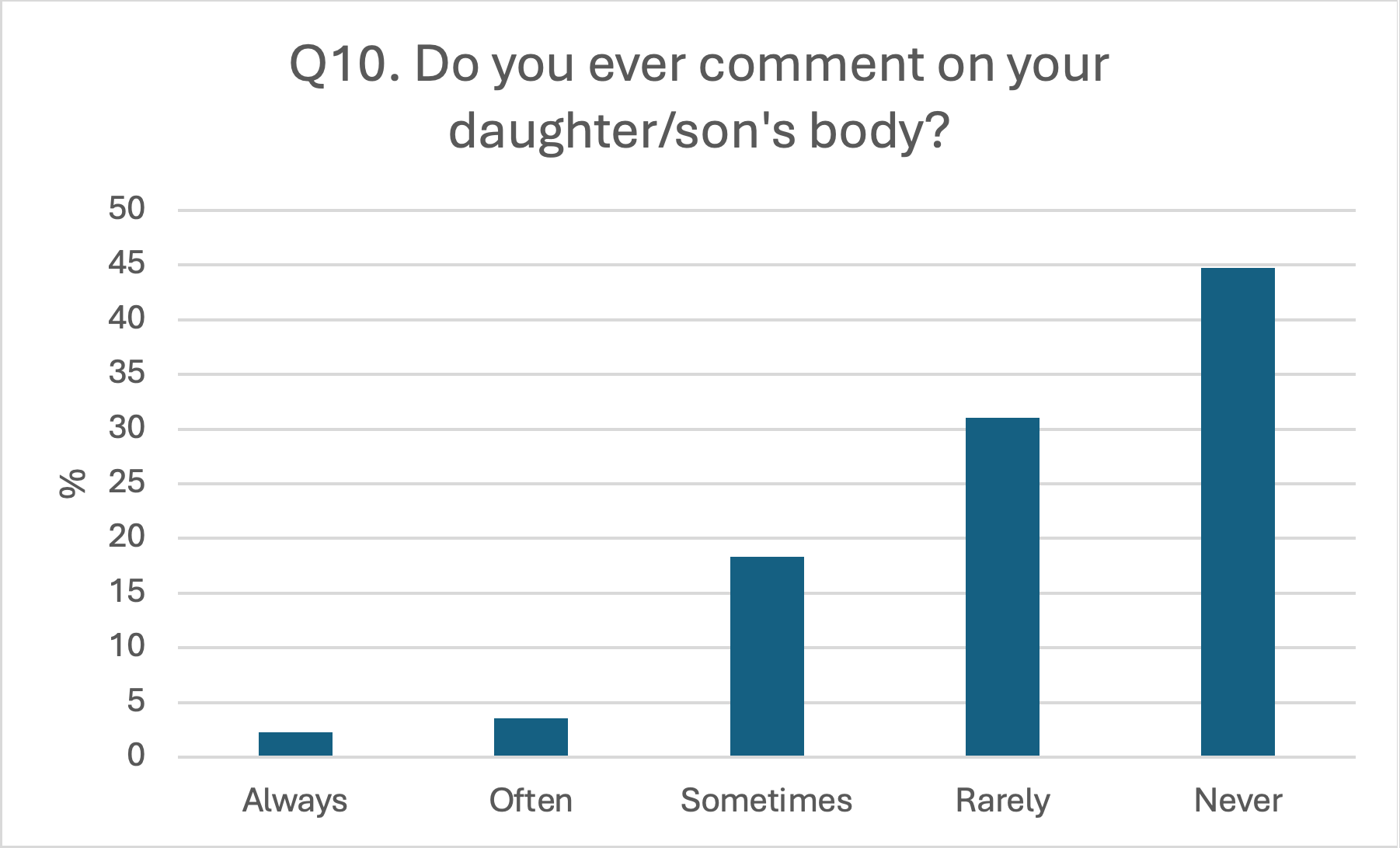
Commenting on the body (even positively) can influence young people’s self-esteem and foster insecurities. It is encouraging to note that over 75% of respondents answered “never” or “rarely,” indicating awareness among parents about how delicate it is to make explicit comments on their children’s physical appearance. However, 5.9% (“always” + “often”) of parents habitually make comments that may negatively impact their children’s relationship with food.
Q11. Do you find yourself comparing your child’s body to that of others?
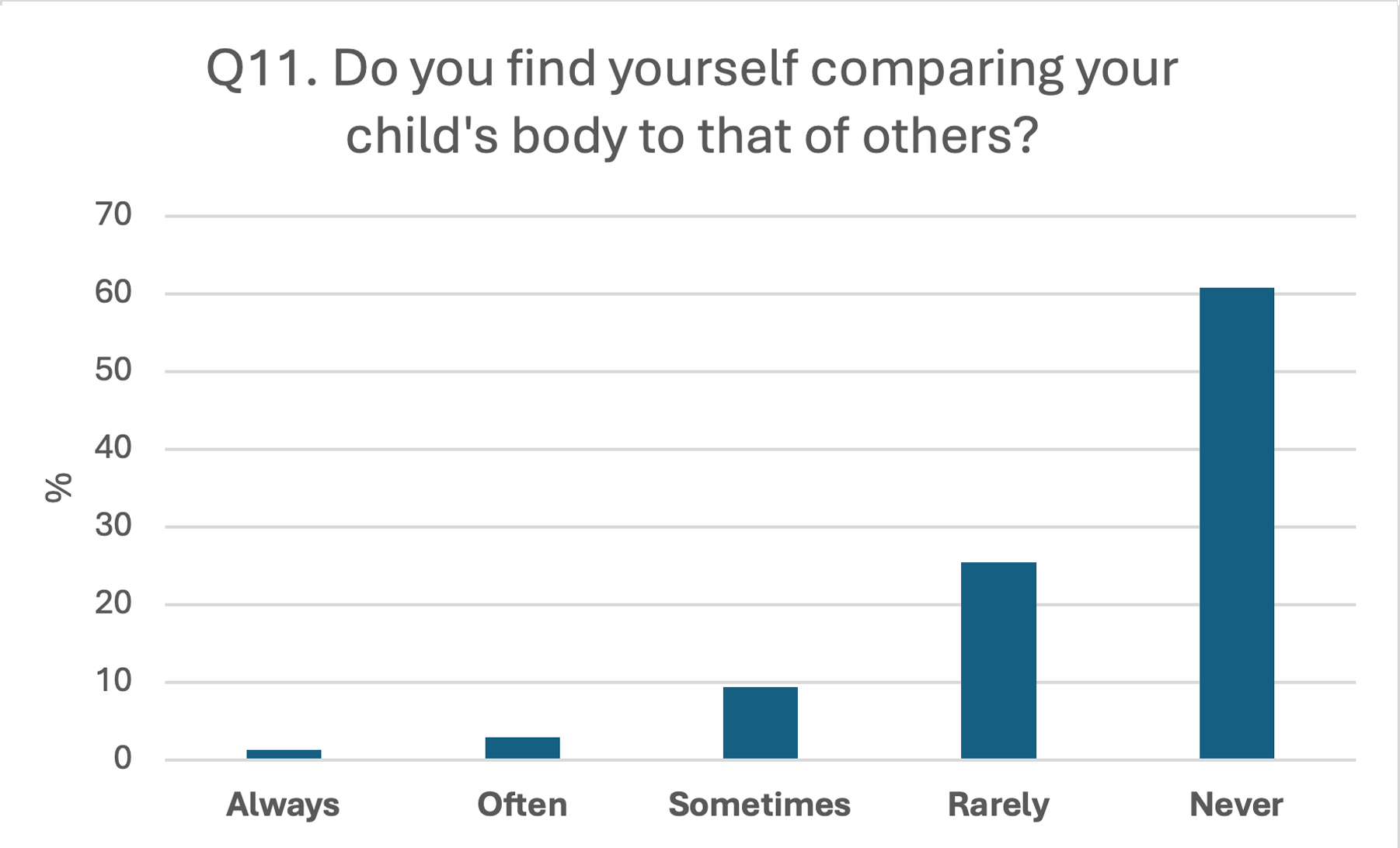
Comparing physical appearance with peers or external models is a well-documented risk factor. As with Q10, for Q11 it is worth noting that over 85% of respondents answered “never” or “rarely,” indicating awareness among parents about how sensitive it is to make explicit comparisons regarding their children’s physical appearance. However, 4% (“always” + “often”) of parents regularly make comparisons that could negatively affect their children’s relationship with food.
Q14. Does your child prefer diet products (low in calories)?

This question may indicate a family’s attention to foods commonly perceived as healthy. However, the fact that very young individuals prefer “light” products may reveal a potentially unhealthy relationship with food. In this case as well, 80% of respondents reported that their children do not prefer these products. Perhaps more concerning than the 14% of young people who do prefer them is the 5.9% of parents who do not know their children’s preferences.
Conclusions
The analysis of parental responses highlights a complex interplay between awareness of healthy habits and the persistence of attitudes that may inadvertently contribute to the development of disordered eating patterns in children. While the majority of parents reported behaviors and beliefs aligned with a supportive and balanced approach to food and body image, a notable minority endorsed attitudes, such as linking self-worth to weight, making comments on their child’s body, or encouraging the consumption of diet products, that research has consistently associated with increased vulnerability to body dissatisfaction and eating disorders. Of note, two respondents out of 306, both from the same project partner, answered “yes” to all five questions; 4 answered “yes” to 4 out of 5 questions; 7 answered “yes” to 3 out of 5 questions. Overall, these responses suggest that these parents may be transmitting to their children messages and behavioral models related to weight, physical shape, and calorie control all factors that scientific literature associates with greater vulnerability to developing eating disorders, especially when combined with other risk factors (school, sports, or social pressures).
These findings reinforce the central role of the family environment in shaping a child’s relationship with food and physical appearance. Even infrequent comments, comparisons, or emphasis on calorie control can, over time, influence a young person’s self-perception and eating behaviors, particularly in the context of other risk factors such as social pressures or sports-related performance demands. The fact that some parents were unaware of their children’s food preferences further suggests that communication gaps within the family may also contribute to misunderstandings and potentially harmful assumptions about health and nutrition.
Addressing these risk factors requires a dual approach: raising parental awareness about the subtle ways their attitudes and behaviors influence their children, and equipping them with practical strategies to foster a positive, health-focused environment. Educational initiatives, parental workshops, and open dialogue between families and professionals can help shift the emphasis from appearance and weight toward functionality, well-being, and self-acceptance.
Ultimately, preventing the development of eating disorders is not solely a matter of identifying at-risk individuals but also of cultivating protective factors within the home. Parents who consciously model balanced nutrition, respect for body diversity, and healthy coping mechanisms can act as powerful buffers against the societal pressures that often drive disordered eating. By promoting these values consistently, families can help children build resilience, confidence, and a sustainable, positive relationship with food and their bodies that extends well into adulthood.
References
- Bauer, K.W.; Berge, J.M.; Neumark-Sztainer, D. The Importance of Families to Adolescents’ Physical Activity and Dietary Intake. Adolesc Med State Art Rev 2011, 22, 601–613, xiii.
- Neumark-Sztainer, D. Preventing the Broad Spectrum of Weight-Related Problems: Working with Parents to Help Teens Achieve a Healthy Weight and a Positive Body Image. J Nutr Educ Behav 2005, 37 Suppl 2, S133-140, doi:10.1016/s1499-4046(06)60214-5.
- Francisco, R.; Narciso, I.; Alarcão, M. Individual and Relational Risk Factors for the Development of Eating Disorders in Adolescent Aesthetic Athletes and General Adolescents. Eat Weight Disord 2013, 18, 403–411, doi:10.1007/s40519-013-0055-6.
- Klein, K.M.; Brown, T.A.; Kennedy, G.A.; Keel, P.K. Examination of Parental Dieting and Comments as Risk Factors for Increased Drive for Thinness in Men and Women at 20-Year Follow-Up. Int J Eat Disord 2017, 50, 490–497, doi:10.1002/eat.22599.
- Winograd, D.; Goldschmidt, A.B.; Lydecker, J. Associations among Parents’ Internalized Weight Bias, Negative Child-Focused Body Talk, and Feeding Behaviors. Eat Behav 2024, 52, 101848, doi:10.1016/j.eatbeh.2024.101848.
- McLean, S.A.; Paxton, S.J. Body Image in the Context of Eating Disorders. Psychiatr Clin North Am 2019, 42, 145–156, doi:10.1016/j.psc.2018.10.006.
- Rodgers, R.F.; Paxton, S.J.; Chabrol, H. Effects of Parental Comments on Body Dissatisfaction and Eating Disturbance in Young Adults: A Sociocultural Model. Body Image 2009, 6, 171–177, doi:10.1016/j.bodyim.2009.04.004.
- Gray, H.L.; Buro, A.W.; Sinha, S. Associations Among Parents’ Eating Behaviors, Feeding Practices, and Children’s Eating Behaviors. Matern Child Health J 2023, 27, 202–209, doi:10.1007/s10995-022-03572-6.
- Pallotto, I.K.; Sockol, L.E.; Stutts, L.A. General and Sport-Specific Weight Pressures as Risk Factors for Body Dissatisfaction and Disordered Eating among Female Collegiate Athletes. Body Image 2022, 40, 340–350, doi:10.1016/j.bodyim.2022.01.014.
- Balantekin, K.N. The Influence of Parental Dieting Behavior on Child Dieting Behavior and Weight Status. Curr Obes Rep 2019, 8, 137–144, doi:10.1007/s13679-019-00338-0.